India-Korea Partnership: Strategic Significance in the Contemporary Times
Date: 19 Aug 2026
Mata Sundri College for Women Hosts Special Lecture on India-Korea Relations and Strategic Partnership
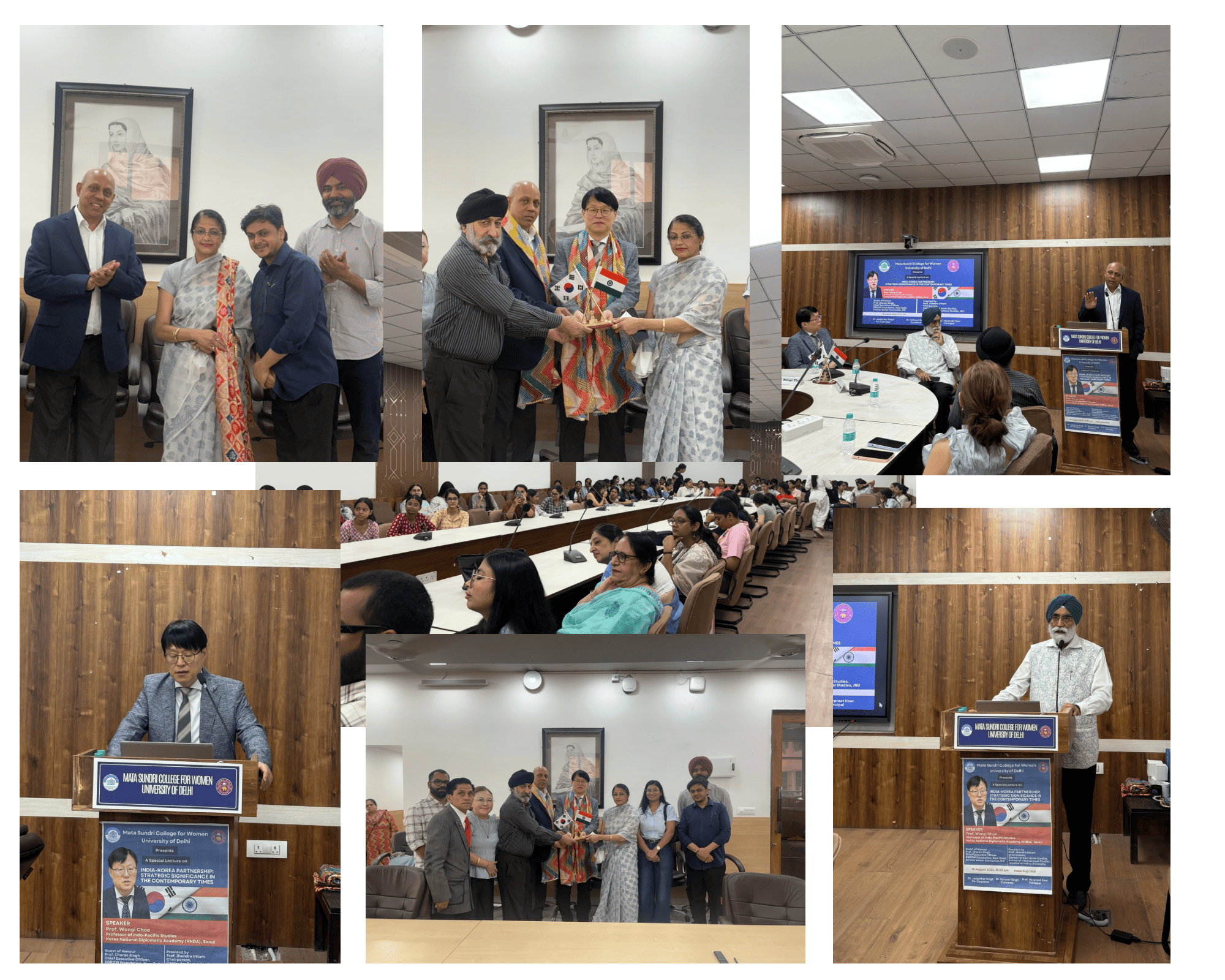
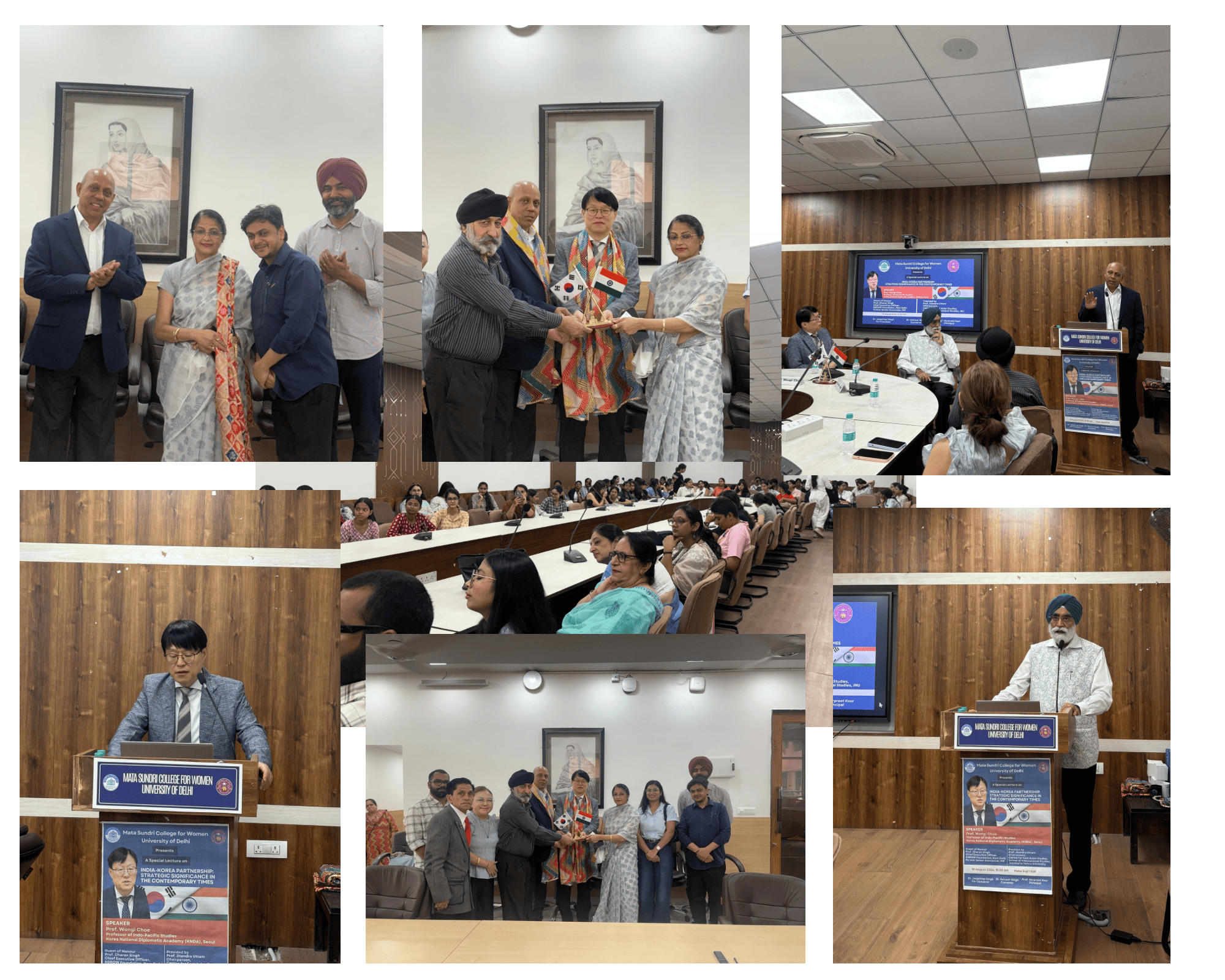
Mata Sundri College for Women, University of Delhi, organised a special lecture on “India-Korea Partnership: Strategic Significance in the Contemporary Times” on 18 August 2026 at Mata Gujri Hall. The lecture was delivered by Prof. Wongi Choe, Professor of Indo-Pacific Studies, Korea National Diplomatic Academy (KNDA), Seoul.
The programme was presided over by Prof. Jitendra Uttam, Chairperson, Centre for East Asian Studies, School of International Studies, Jawaharlal Nehru University. Prof. Chanan Singh, Chief Executive Officer, EGROW Foundation, New Delhi and Former Senior Economist, IMF, graced the occasion as the Guest of Honour. The event was also attended by Prof. Harpreet Kaur, Principal, Mata Sundri College for Women, along with the faculty and students of the College.
The session began with the welcome and introduction of the speaker by the presiding dignitary, setting the context for an engaging discussion on the evolving India-Korea relationship.
Delivering an insightful lecture, Prof. Wongi Choe explored why India and Korea constitute natural, complementary and strategically significant partners. He highlighted the historical and cultural connections between the two countries, including civilizational links extending back nearly two millennia and the influence of Buddhism on Korean culture.
Prof. Choe also discussed India’s contribution during the Korean War, particularly the humanitarian role of the 60th Parachute Field Ambulance and India’s leadership of the Neutral Nations Repatriation Commission.
A significant part of the lecture focused on the economic complementarities between the two countries. Prof. Choe emphasised Korea’s strengths in advanced technology and high-tech manufacturing alongside India’s large domestic market, skilled and competitive workforce, and expanding digital and innovation ecosystem.
The lecture further examined the strategic convergence between India and Korea in the Indo-Pacific. Prof. Choe underlined the importance of India’s rise for Korea’s strategic interests and argued for building stronger strategic trust between the two countries. He also addressed challenges within the partnership, including limited sustained engagement and differences in expectations regarding trade, investment and technology.
The lecture was followed by remarks from Prof. Chanan Singh, who shared his observations on the significance of the discussion and the broader relevance of India-Korea relations. The programme concluded with remarks by Prof. Jitendra Uttam, who reflected on the key insights of the lecture and emphasised the importance of strengthening academic and strategic conversations on contemporary international relations.
The session provided students and faculty with an enriching opportunity to engage with questions of diplomacy, international cooperation, economic partnership and the changing strategic landscape of the Indo-Pacific. The lecture concluded on the note that India and Korea possess considerable potential as natural and complementary partners and that stronger strategic trust can provide a foundation for a deeper partnership in the future.