Khelo India Samvaad 2026 at Mata Sundri College: Youth Voices, Sporting Aspirations and a Vision for Viksit Bharat
Date: 27 Aug 2026
From the Prime Minister’s National Address to an Open Yuva Samvaad with Union Minister Shri Shivraj Singh Chouhan, the programme placed students at the heart of India’s sporting and nation-building journey
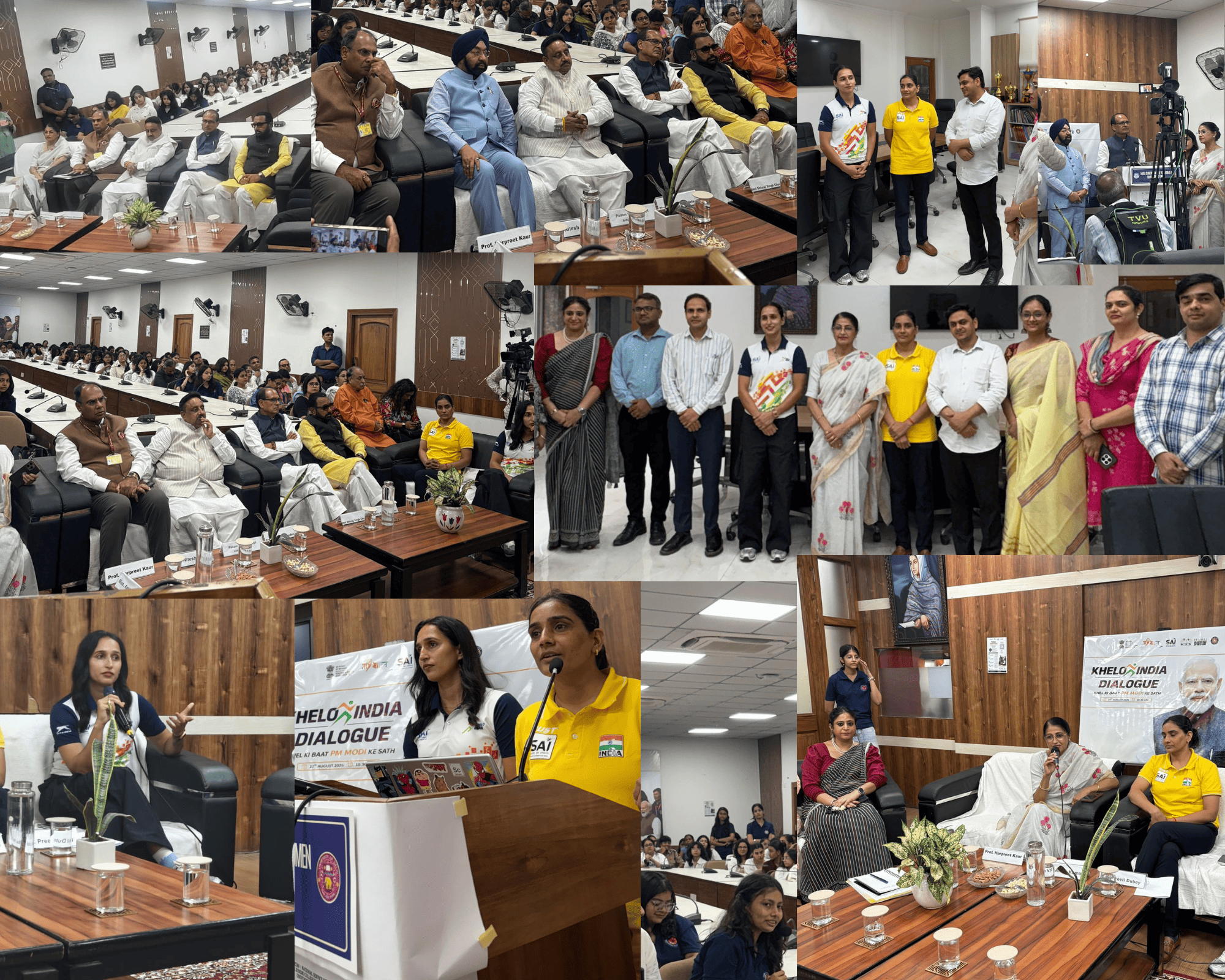
Mata Sundri College for Women, University of Delhi, became a vibrant platform for youth participation, sporting aspirations and national dialogue on 27 August 2026 as it hosted the Khelo India Samvaad – “Khel Ki Baat PM Ke Saath” at Mata Gujri Hall. Organised under the aegis of Mera Yuva Bharat (MY Bharat), Department of Youth Affairs, Ministry of Youth Affairs & Sports, Government of India, the programme brought together students, sportspersons, public representatives and the wider youth community in a dialogue centred on sports, fitness, youth leadership and the vision of Viksit Bharat.
The nationwide initiative was organised as part of the celebrations leading up to National Sports Day, commemorating the birth anniversary of legendary hockey player Major Dhyan Chand. The programme sought to place young people at the centre of India’s sporting journey by giving them an opportunity not only to listen, but also to express their aspirations, identify challenges and contribute ideas for the future of Indian sports and youth development.
The programme commenced with the reporting of MY Bharat volunteers and the college team, followed by comprehensive preparations for the national live feed, audio-visual systems, stage and venue arrangements. The reception of dignitaries and local sporting personalities set the tone for a programme that brought together national leadership and grassroots youth participation.
As the national segment began, students and participants gathered for the virtual programme, which featured the arrival of Hon’ble Prime Minister Shri Narendra Modi through the live national feed. The proceedings included a welcome to the Prime Minister, an address by Dr. Mansukh Mandaviya, Hon’ble Union Minister for Youth Affairs and Sports, a special film highlighting the significance of National Sports Day, and highlights from the Prime Minister’s Independence Day address concerning sports.
The Prime Minister’s address provided a larger national context to the gathering, connecting India’s sporting ambitions with youth participation, fitness, Olympic aspirations and nation-building. The Khelo India Samvaad brought young people from thousands of institutions across the country onto a common platform, creating a nationwide conversation on the future of sports and the role of youth in building a stronger and more confident India.
Following the conclusion of the national address, the programme at Mata Sundri College transitioned into the local Yuva Samvaad, transforming the venue from a viewing platform into a space for direct interaction and exchange.
The programme was conducted under the guidance and leadership of Professor Harpreet Kaur, Principal, Mata Sundri College for Women, whose support and encouragement contributed significantly to the successful organisation of the event and provided an enabling environment for meaningful student participation and dialogue.
The college was honoured by the presence of Shri Shivraj Singh Chouhan, Hon’ble Union Minister of Agriculture and Farmers Welfare and Rural Development, Government of India, who interacted directly with the students. The programme was further graced by the presence of Padma Shri Dr. Vikramjit Singh Sahney, Chairman, Governing Body, Mata Sundri College for Women and Member of Parliament, Rajya Sabha. The gathering also welcomed Shri Prataprao Ganpatrao Jadhav, Hon’ble Minister of State (Independent Charge), Ministry of AYUSH, and Minister of State, Ministry of Health & Family Welfare, Government of India. Also present were Shri Nitesh Kumar Mishra, Additional Secretary, Department of Youth Affairs, and Shri Praveen Khandelwal, Hon’ble Member of Parliament, Lok Sabha, Chandni Chowk Parliamentary Constituency. Alongside these distinguished guests, the programme also welcomed two accomplished sportspersons—Ms. Amita Kumari, Yogasana athlete, and Ms. Preeti Dubey, Hockey player—whose presence brought the experiences and aspirations of competitive sport closer to the students.
Welcoming the gathering, Shri Shivraj Singh Chouhan emphasised the importance of involving young people in the process of nation-building and encouraging them to contribute meaningfully to the vision of Viksit Bharat. He highlighted that the development of young people cannot be viewed only through the lens of academics and stressed the equal importance of sports in shaping a disciplined, confident and resilient personality. Sports, he emphasised, are not merely about competition or medals; they contribute to character, self-confidence, discipline and the holistic development of young people.
A defining feature of the programme was the open Yuva Samvaad, where students were invited to come forward and present their ideas and suggestions. The platform was kept open so that students could speak directly and freely, with each participant being given adequate time to articulate their concerns and proposed solutions. This transformed the interaction into a genuine dialogue rather than a one-way address.
The students’ suggestions reflected a broad and thoughtful understanding of the challenges facing Indian sports and youth development.
A major theme was mental health and sports psychology. Students suggested the introduction of a regular mental-skills module at Khelo India Centres and government sports academies, focusing on stress management, concentration, motivation, performance pressure, resilience and coping with failure. The students highlighted that sporting ability alone is not sufficient to succeed at competitive levels and that athletes must also be equipped to manage pressure, setbacks and expectations.
The need for stronger sporting opportunities in rural and remote areas emerged as another important concern. Students called for improved sports infrastructure, affordable and accessible equipment, trained coaches, regular awareness programmes and greater exposure to sporting opportunities. Particular emphasis was placed on ensuring that students from rural and economically disadvantaged backgrounds are not prevented from pursuing sports because of a lack of resources. Suggestions included local training centres, equipment support and programmes through which young people could learn the sport of their choice.
Students also stressed the importance of creating a supportive environment around young athletes. They proposed awareness and sensitisation programmes for parents and teachers, noting that family and educational pressures can sometimes discourage students from pursuing sports despite their talent and interest. Greater awareness of sporting careers and opportunities was also recommended so that students and their families can make informed decisions about pursuing sports professionally.
Another important suggestion concerned medical care and rehabilitation for athletes. Drawing upon experiences of sporting injuries, students proposed that educational institutions should have access to professional medical and rehabilitation teams so that injured athletes can receive timely treatment, rehabilitation and psychological support and return to sporting activities with confidence.
The question of athlete nutrition was also brought to the forefront. A proposal was made for a National Athlete Nutrition Support Programme under the broader vision of Viksit Bharat, providing athletes with scientifically designed and medically evaluated diet plans based on their sport, training requirements and individual nutritional needs. The suggestion also highlighted the need to account for vegetarian and non-vegetarian preferences, allergies, regional food availability and the financial circumstances of athletes, while ensuring that any nutritional supplements provided meet appropriate quality and anti-doping standards.
The students further brought youth participation and civic responsibility into the discussion. One proposal suggested that districts could identify local challenges and engage young people through MY Bharat to develop practical solutions with their communities, with promising ideas receiving mentorship and support for implementation. The suggestion envisioned volunteering not merely as participation in programmes, but as an opportunity for young people to exercise leadership and take responsibility for solving real challenges around them.
The dialogue also addressed the need for a drug-free India. A suggestion was made for a secure and anonymous digital mechanism through which cases of drug or substance abuse could be reported with supporting evidence while protecting the identity and privacy of the reporter. The proposal sought to combine public awareness with a rapid and secure mechanism for action.
Shri Shivraj Singh Chouhan listened attentively to the suggestions put forward by the students and appreciated their thoughtful and practical nature. He assured the participants that feasible suggestions would be conveyed to the concerned departments for further consideration and action. He also emphasised the importance of giving greater attention to mental health, nutrition and the development of sports in rural areas.
The Hon’ble Minister further administered the Nasha Mukt Bharat pledge to the students, reinforcing the message that healthy, fit and drug-free youth are central to the nation’s future. The interaction thus extended beyond sporting excellence to encompass physical well-being, mental resilience, responsible citizenship and the larger development of young people.
The presence of sportspersons Ms. Amita Kumari and Ms. Preeti Dubey added another dimension to the interaction, enabling students to connect the larger policy conversation with the lived experiences of athletes. Their participation reinforced the message that sporting dreams can emerge from diverse backgrounds and that young people require opportunity, encouragement, training and sustained support to translate talent into achievement.
The programme concluded with a vote of thanks and a MY Bharat portal registration drive, followed by the National Anthem. The concluding moments included a group photograph, media interaction and a Fit India activity, bringing the day’s message of participation, fitness and collective responsibility to a close.
The Khelo India Samvaad at Mata Sundri College was therefore more than a sporting event. It became a meaningful platform where national vision met student voices. From listening to the Prime Minister’s message on India’s sporting future to directly presenting ideas before a Union Minister, students were given an opportunity to participate in a conversation that connected sports with education, mental well-being, nutrition, accessibility, rural development, youth leadership and nation-building.
The event reaffirmed the idea that the journey towards Viksit Bharat is not shaped by policymakers alone. It is also shaped by the ideas, aspirations and participation of young citizens. At Mata Sundri College, the students did not merely listen to a conversation about the future of India—they were invited to become contributors to it.
Khelo India Samvaad 2026 thus left behind a powerful message: when young voices are given a platform, sport becomes more than a game—it becomes a pathway to confidence, leadership, inclusion and nation-building.