Two-Day National Workshop on “Sikh Martyrdom in Indian History (c.1500–1765)”
Date: 04 Dec 2025
Organised by Mata Sundri College for Women, University of Delhi in collaboration with Centre for Independence and Partition Studies (CIPS), University of Delhi
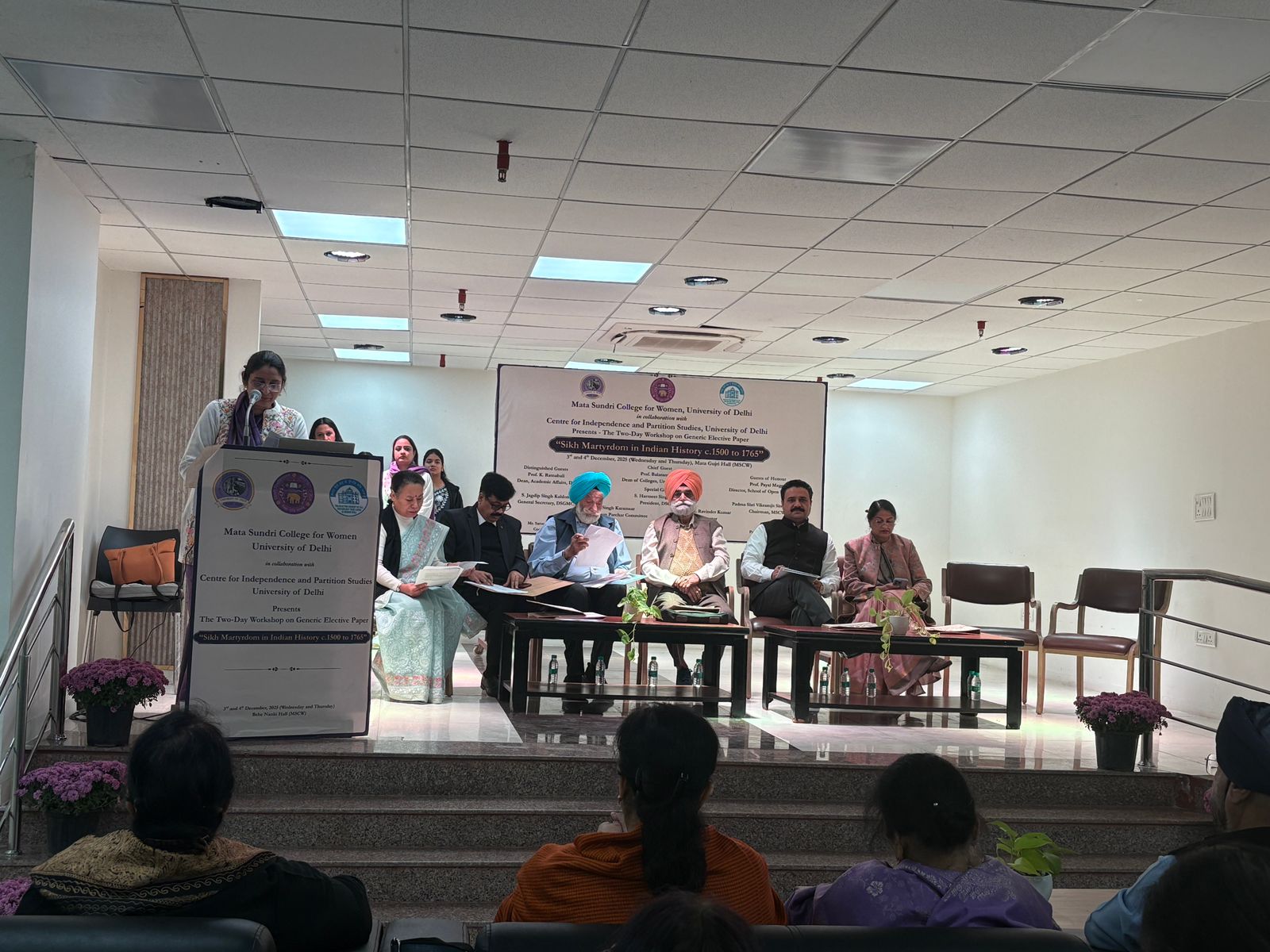
Mata Sundri College for Women, University of Delhi, in collaboration with the Centre for Independence and Partition Studies (CIPS), University of Delhi, organised a two-day faculty workshop on the Generic Elective paper titled “Sikh Martyrdom in Indian History (c.1500–1765)” on 3rd and 4th December 2025 at Mata Gujri Hall, Mata Sundri College for Women.
The workshop was conducted exclusively for faculty members and focused on discussions related to Sikh martyrdom in Indian history from the sixteenth to the eighteenth century. Across the two days, the sessions addressed the historical framework, key developments, and thematic concerns of the topic as prescribed in the Generic Elective syllabus. The deliberations remained centred on the academic content of the paper and its relevance for classroom teaching and learning. The event was successfully conducted over both days.
The workshop was graced by the presence of the Chief Guest, Prof. Balaram Pani, Dean of Colleges, University of Delhi. The Guests of Honour were Prof. K. Ratnabali, Dean, Academic Affairs, University of Delhi, and Prof. Payal Maggo, Director, School of Open Learning, University of Delhi. The Chairman, Mata Sundri College for Women, Padma Shri Vikramjit Singh Sahney, was also present on the occasion.
The Special Guests from the Delhi Sikh Gurdwara Management Committee (DSGMC) included S. Jagdip Singh Kahlon, General Secretary, DSGMC; S. Harmeet Singh Kalka, President, DSGMC; and S. Jaspreet Singh KaramSar, Chairman, Dharam Parchar Committee (DSGMC). Prof. Ravinder Kumar, Director, Centre for Independence and Partition Studies (CIPS), was also present as a Special Guest during the workshop.
The workshop was held under the guidance of Prof. Harpreet Kaur, Principal, Mata Sundri College for Women, and was attended by faculty members from the institution. The two-day academic engagement followed a structured schedule of sessions and discussions aligned with the content of the Generic Elective paper.